

Know Your Enemy and Act Accordingly

Presidents Truman, Eisenhower, Kennedy, Johnson, Nixon, Ford, Carter, Reagan and George H.W Bush were cold warriors. Forged in the thirties and forties, these Presidents learned the reality that evil existed in the world, and often could not be reasoned with.
The mistakes of appeasement were seared into their memories. When the Soviet Union was caught sending missiles to Cuba, in 1962, President Kennedy drew a line in the sand.
The 1930’s taught us a clear lesson; aggressive conduct, if allowed to go unchecked and unchallenged, ultimately leads to war.
We learned our lesson: appeasing aggressors doesn’t work. The wars in Korea and Viet Nam were based on that principal.
However, it’s not as simple as “appeasement is bad and should be avoided.” Look at it from their point of view.
When fascist storm clouds in Europe were darkening in the twenties and thirties, and the Japanese empire was expanding in Asia, the allies remembered their shock and horror at the unexpected carnage of The First World War. The agony of a generation of young men plowed under was only a decade or two in the past. War monuments in European towns provided a tangible reminder that war is not a game of fancy uniforms and pieces moved around on a map. Was it not better to negotiate, to reason, to talk, to compromise, to do anything to prevent another European bloodbath. Who could blame them? Nobody wanted a repeat of The Great War of 1914 – 1918.
But they got it anyway.
They made the mistake of not understanding that the Germans and Japanese had different perspectives. Of course they want peace. Everyone wants peace. Don’t they?
After World War I, President Woodrow Wilson whistle-stopped around the country, begging the country to join the newly established League of Nations. If the world has a forum to discuss international conflicts, we might be able to put an end to war.
Well - the League didn’t work, and the United States’ “return to normalcy and isolation” didn’t work, and disarmament conferences didn’t work, and peace pacts didn’t work, and negotiations didn’t work, and the United Nations after World War II didn’t work. All that effort to give peace a chance as the Beatles sang in the sixties, didn’t work.
OUR PREMISES ABOUT LIFE ARE MILES APART
Why does negotiation often fail? Because negotiation presupposes like-mindedness and a willingness to compromise. The failure of the allies to understand this led to the deaths – deaths – of around 75 - 80 million people.
Columnist William Safire, talking to Soviet journalists in the late eighties, concluded, “We do not even live on the same planet…Our data bases did not even touch.” Our premises about life are miles apart. As a result, Safire wrote, “mutual misunderstanding widens the gulf between us”. The Secretary of Defense at the time, Caspar Weinberger, urged wariness with the Soviets.
We must take care not to assume that other nations think and act as we do.
It couldn’t be any clearer than that.
At the Yalta conference in February,1945, with the Soviet army moving ever eastward, the Soviet dictator, Stalin, agreed to allow free elections in eastern Europe after the war. He had no intention of keeping his word, and assumed Roosevelt understood that. Roosevelt and later President Truman, being honest (and naïve) Americans, believed him.
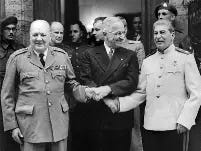
“I like Stalin,” Harry Truman wrote to his wife, Bess on July 29, 1945, after meeting him at the Potsdam conference. “He is straightforward. Knows what he wants and will compromise when he can’t get it.”
Truman, the small-town, mid-western American, was an honest man. Wasn’t everyone? Isn’t a deal a deal? After all, they promised.
Psychologist, M. Scott Peck wrote that people have, “vastly different views as to the nature of reality, yet each one believes his or her own view to be…correct.” He cited a study that found that “the basic assumptions of the Soviets and Americans were worlds apart, yet neither side was aware of the gap. Each thought the other was either crazy or deliberately evil.”
AND SO IT GOES TODAY
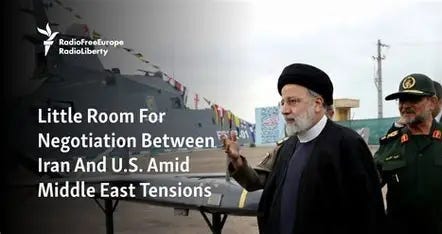
“Negotiations” between Iran and the United States, prior to the outbreak of the war, illustrate the difficulty, if not the impossibility, of reconciling different mind-sets.
Late last week,Steve Witkoff, America’s chief negotiator, reported:
Both the Iranian negotiators said to us, directly, with, you know, no shame, that they controlled 460 kilograms of 60%, and they’re aware that that could make 11 nuclear bombs, and that was the beginning of their negotiating stance…
Their negotiators said that Iran had the “inalienable right to enrich all their nuclear fuel.”
Did the Iranians actually believe they could intimidate the United States by flexing their nuclear muscles? You better compromise and back off, if you know what’s good for you…
What were they thinking? When you are sitting at the poker table with a pair of tens, and the guy across from you has a full house, it’s not a good time to bluff.

Maybe their posturing was a negotiating tactic; maybe it was part of slow walking the negotiations in order to buy time. Who knows? It’s hard to understand people who do not even live on the same planet…
ENDURING DELUSIONS
Just this week, Moral Clarity Substack writer, Nachum Kaplan, echoed these ideas.
One of the West’s most enduring delusions about the Middle East is temporal. It assumes that everyone thinks like Washington, Brussels, or Canberra: in election cycles, quarterly earnings reports, and news cycles that expire before the next streaming series drops.
The Middle East is home to ancient cultures. Tribal loyalties, religious doctrines, dynastic rivalries, and historical grievances are not abstractions; they are living forces. When regional actors make plans, they do so with a patience that is alien to Western sensibilities.
The West finds this unsettling because it prefers universalist narratives about integration, coexistence, and post-historical peace. Those narratives have merit within stable liberal democracies but do not automatically translate to civilizations that theological and historical memories are still shaping.
Exactly. When reality is challenged by idealism, when nuance is sacrificed to oversimplification, when wishful thinkers opt to die on the hill of their misconceptions, when “coexistence” becomes an unrealistic mantra denying humanity’s tribal nature, when we don’t call evil by its name, when we assume that our antagonists want what we want, and if they are willing to die for the 72 virgins, then we might suffer the dangerous consequences of our enduring delusions.
CRISIS highly recommends the essay by Moral Clarity.
Copy and paste this link into your browser for the complete essay.
The sundial and the stopwatch - by Nachum Kaplan
To paraphrase the well-known comments of a diplomat, this is why the Arabs and the Israelis cannot reconcile their differences “like good Christians.”
Much of the US does not think like Washington DC, why do they think really alien cultures will? For the tribe, violence is honor and honor is life; if the other tribe thinks you will not respond you're toast. That has been true through history, but it seems to be unrecognized by many. (What if they gave a war and nobody came? Then the war will come to you.) If you don't mind, a link to my essay on war.
https://drp314.substack.com/p/some-disjointed-thoughts-on-war